1The idea
On a cold call you are doing three things at once: listening, deciding where the conversation is, and deciding what to do next. The second is the one people lose under pressure. The question I wanted to answer was simple: does a map you can glance at help?
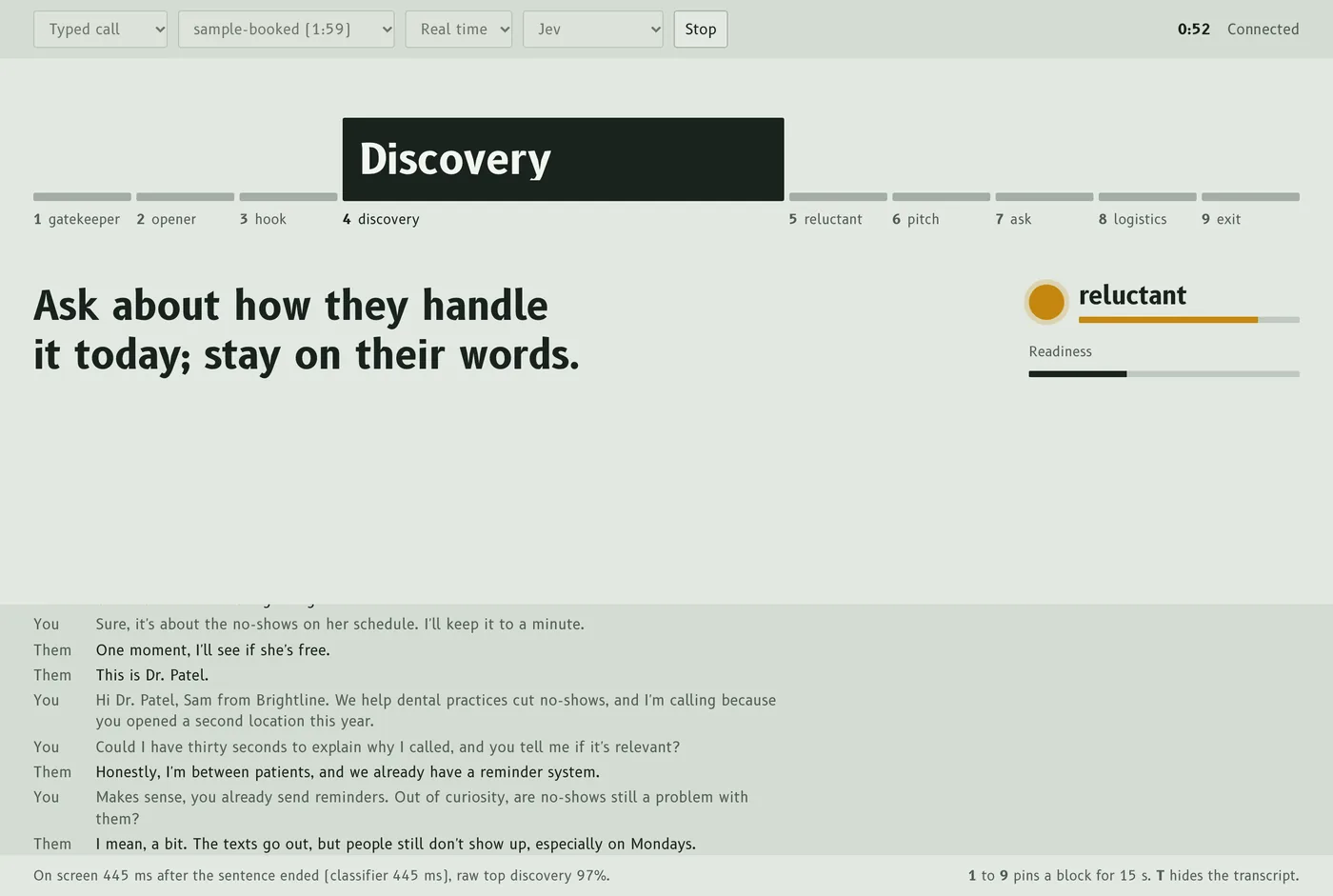
The map has nine blocks: gatekeeper, opener, hook, discovery, reluctant, pitch, ask, logistics and exit. The screen lights the block you are in, shows a lamp for the other person's stance, and prints one line of direction. It never writes what to say. The directions come from a playbook file you edit, not from a model.
2How it works
Two channels, not one. The browser captures your microphone and the other side of the call (from a Chrome tab or a virtual audio device) as two separate channels. That way the system knows who said what without guessing from one mixed recording.
Words stream, sentences trigger. Deepgram transcribes both channels live. As soon as a sentence ends, either because the speaker starts the next one or after 350 ms of quiet, it goes to Jev with the last few lines of the call, labelled You and Them.
One request, several questions. Jev, TypeSafe's fast classification model, answers in one request: which of the nine blocks this is, which of five stances the other person is in, how ready they are, and, for each way out of the current block, whether the call is heading there. Classification costs about $0.006 for a ten-minute call; transcription costs more.
A plain state machine decides the screen. Jev's answer is a set of probabilities. The screen only changes when the rules say so.
3The screen lags on purpose
A classifier reading one sentence at a time can change its mind on every sentence. A screen that followed it would flicker, and a flickering screen is worse than none. So the block on screen only switches when a new block leads twice in a row at 65% or more, or once at 85% or more. Anything under 55% shows as unknown. A stance is averaged over the last three sentences.
| Time | Line | My label | Screen |
|---|---|---|---|
| 34.2s | You: Could I have thirty seconds to explain why I called, and you tell me if it's relevant?Jev said hook at 75%. The rule waits for a second result. | hook | opener |
| 38.9s | Them: Honestly, I'm between patients, and we already have a reminder system.Switched. | reluctant | reluctant |
| 49.5s | Them: I mean, a bit. The texts go out, but people still don't show up, especially on Mondays.“Ask about how they handle it today; stay on their words.” | discovery | discovery |
Table 1. Three sentences from a replay of the sample call through Jev. On the first, Jev already had the right block, and the screen waited one sentence before following.
- Typed transcript, 27 sentences
- Generated audio through Deepgram, 61 sentences
Jev's raw block, typed
Screen block, typed
Screen stance, typed
Screen block, audio
Screen stance, audio
agreement with my labels
On the sample call, Jev's top block matched my label on all 27 sentences. The screen matched on 22, and every one of the five misses was the switch rule holding back for one sentence. It never switched to a wrong block. That is the trade I chose: a calm screen is a slightly late screen.
4About a second
To test the full path without placing a call, the project turns a typed call into two-voice audio with the Mac's built-in voices, and streams it through transcription, the sentence splitter, Jev and the state machine, exactly like a live call.
- Transcription (Deepgram)
- Classification (Jev)
Most of the second is transcription. Jev itself takes about a third of a second, so a faster transcriber would matter more than a faster classifier.
5Late is still late
The first live test call showed the flaw in the whole idea: every block lit up 1 to 7 seconds after the caller had already started it. Telling a caller where they are only helps once they are there.
So the screen also shows the next move. Each block in the playbook lists its ways out, each with a trigger in plain words, like “they gave you a moment”. Every request asks Jev about each of them, and a trigger at 70% or more lights the next block ahead of you, with its direction. Replaying that first live test call with this added, “Next” appeared 3.3 seconds before the caller started discovery, 8.9 seconds before the pitch, 11.3 seconds before the ask, and 7.4 seconds before the exit.
6What I take from it
The classifier was the easy part. Jev picked the right block on every sentence of the sample call, in about a third of a second, for a fraction of a cent. The hard parts were everything around it: when to send a sentence, when to believe a result, and when to change the screen.
Where you are is less useful than where you are going. The feature that changed the experience was not better accuracy but the next move, which arrives before you need it.
Hostility is the hard case. On a hand-written hostile call, Jev called every hostile line “reluctant”, and read “How did you get this number?” as the gatekeeper. Telling someone who is annoyed from someone who is busy is exactly what a caller would want help with.
7Limits
- The numbers come from one sample call I wrote and labelled myself, and from audio made with computer voices. Clean text and clean voices are easier than a real call.
- The live test calls are not labelled, so there is no accuracy figure for them. Their recordings stay on my machine.
- Whether the screen actually helps a caller, the question it was built to answer, has not been tested yet.
- Results move a little between runs of the same call.
References
- [1]Code, the playbook, the sample calls and the plan with every measurement: github.com/CodeGeek04/coldcall
- [2]Deepgram, streaming speech to text: deepgram.com
- [3]TypeSafe, makers of Jev: typesafe.ai